Remembering lines
Back to my work
Building
My Journey Chapter Six
Building
TayzoPrompter
Why I built a product that helps technology get out of the way.
It started with people I knew
Some of the best communicators I know find speaking naturally to a camera surprisingly difficult.
They are not nervous because they don't know what to say.
Looking away from the lens
Starting over after losing their place
Over the years I watched friends and family who create content spend more time worrying about those things than actually sharing what they wanted to say.
It became obvious
That observation stayed with me.The technology was asking people to adapt to it
instead of adapting to them.
A different question
Could a teleprompter feel less like a scrolling document and more like a quiet assistant?
Instead of forcing someone to match its pace, what if it could listen and follow theirs?
What if it helped people maintain eye contact and stay present?
What if people could focus on telling their story instead of operating the software?
One question became a product
That question became
TayzoPrompter.
Before the product had an interface
It needed an identity that meant something.
Finding the right name turned out to be almost as challenging as building the software itself. I wanted something that represented communication, not just another application. As the idea evolved, so did the identity behind it.
 T Taylor
Z Zoe
T Taylor
Z Zoe
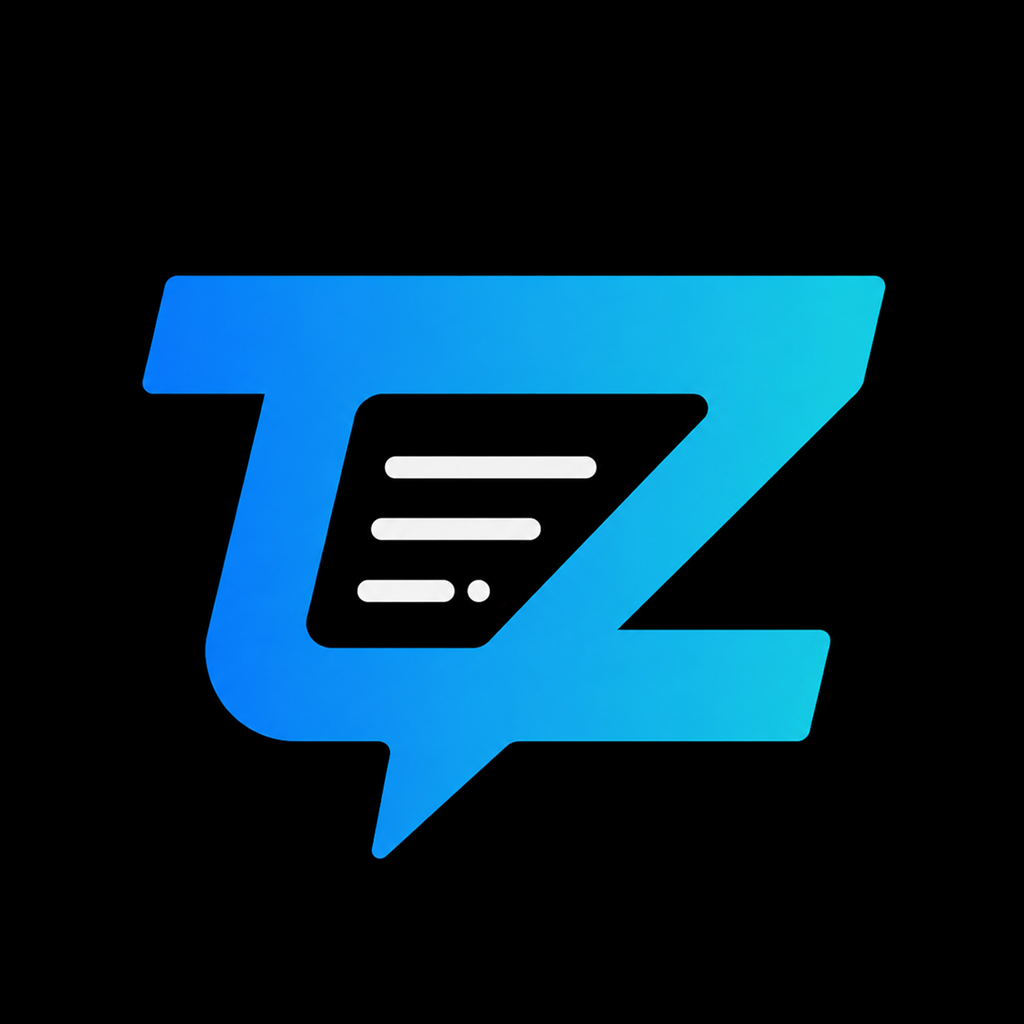
At first glance it looks like a simple speech bubble, a fitting symbol for a product centered around communication.
Look closer and you'll notice it is formed by merging the initials of my two daughters, Taylor and Zoe, into a single “TZ” mark.
It represents both the conversations the software exists to support and the two people who continue to inspire me every day.
A lesson from Fine Arts
The strongest design rarely comes from chasing trends.
Designing that mark reminded me of something I learned years earlier while studying Fine Arts in college.
Strong design comes from giving visual form to something authentic.
AI can generate countless logos in seconds, but it cannot recreate the personal experiences, memories, and relationships that give a design genuine meaning.
That logo is more than branding. It is a small piece of my life woven into the product.
Years later, inside a leading creative agency
I learned that a brand lives in every decision.
Working inside one of the world's leading creative agencies reinforced those lessons in an entirely different way. I came to appreciate that a brand is far more than a logo.
TypographyColorSpacingMotionTone
I remember learning why the agency name mcgarrybowen was intentionally written in lowercase, how specific colors became inseparable from the brand, and how every visual element was treated as part of a much larger identity system.
Those lessons stayed with me.The influence is always there
I don't consciously think about those lessons every time I design something.
But they're there.
NamingInterfaceSpacingAnimationInteraction
TayzoPrompter reflects not only the software I wanted to build, but everything I've learned about creating products that people remember.
Then the idea met reality
Building the application was only part of the journey.
Designing an experience that felt simple across macOS, iPadOS, and iOS proved just as challenging. Every platform introduced different constraints, and every improvement uncovered another decision about how to make the software feel effortless instead of complicated.
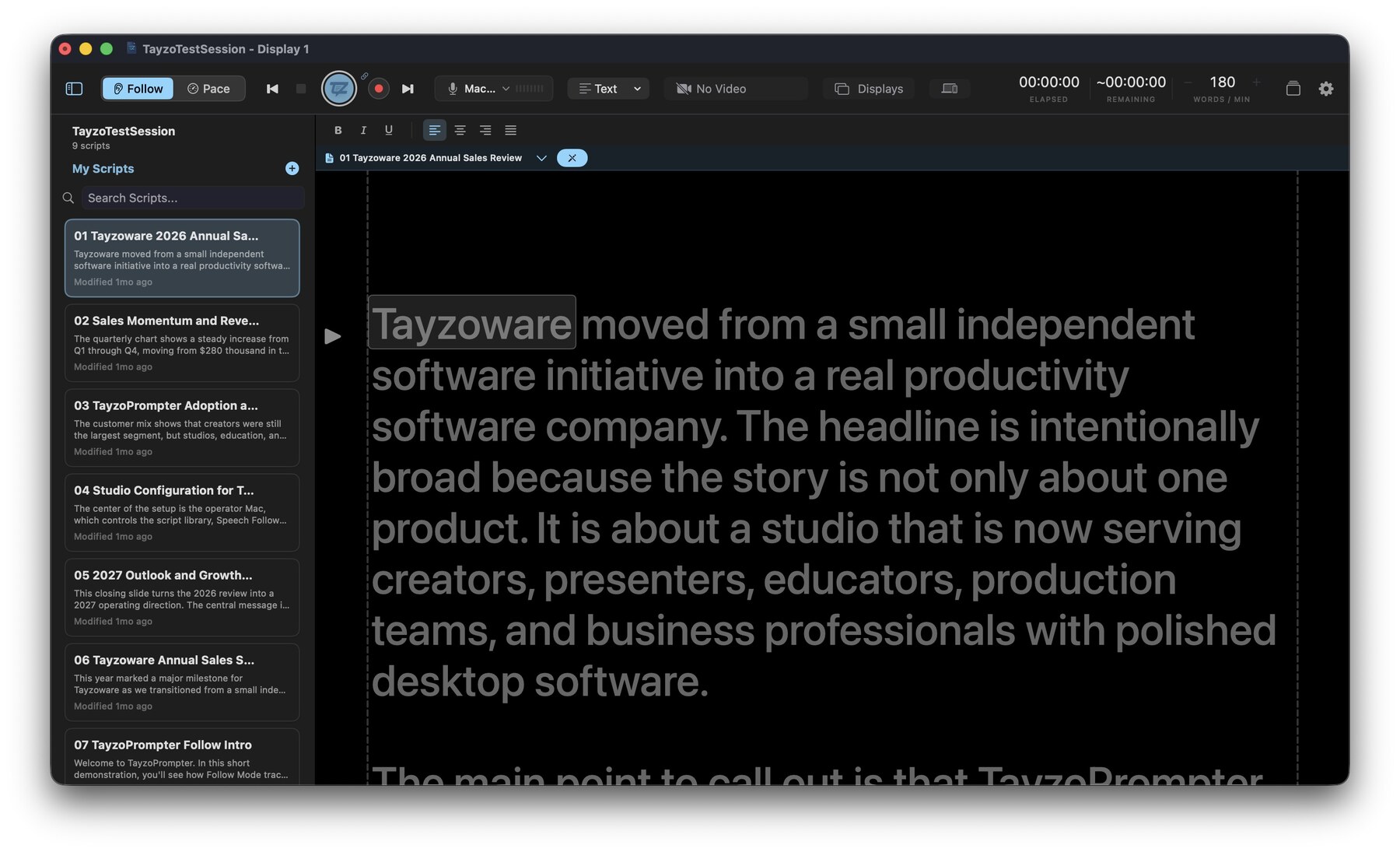
Room to write, rehearse, and record.
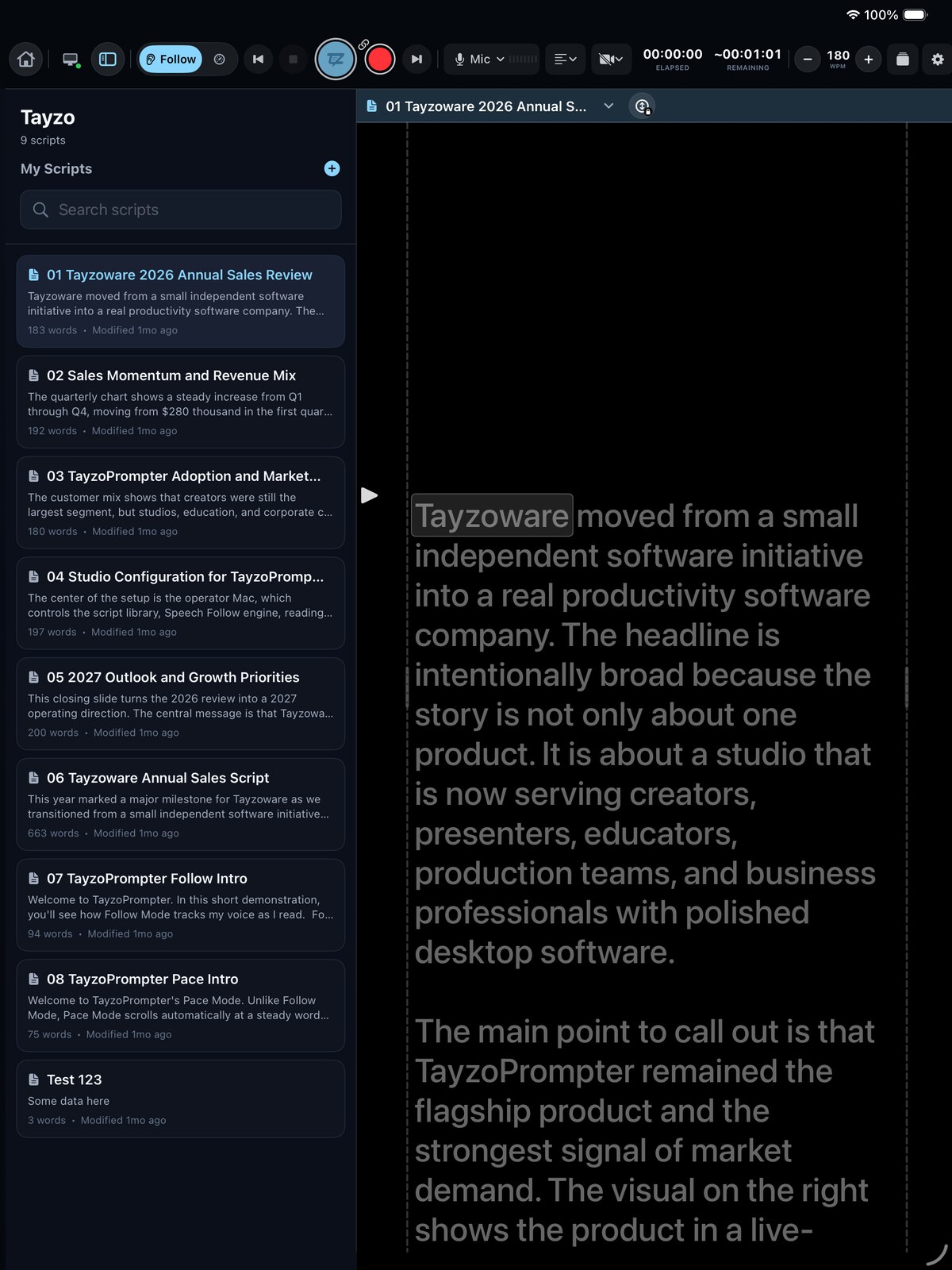
Script library and teleprompter sharing one focused space.
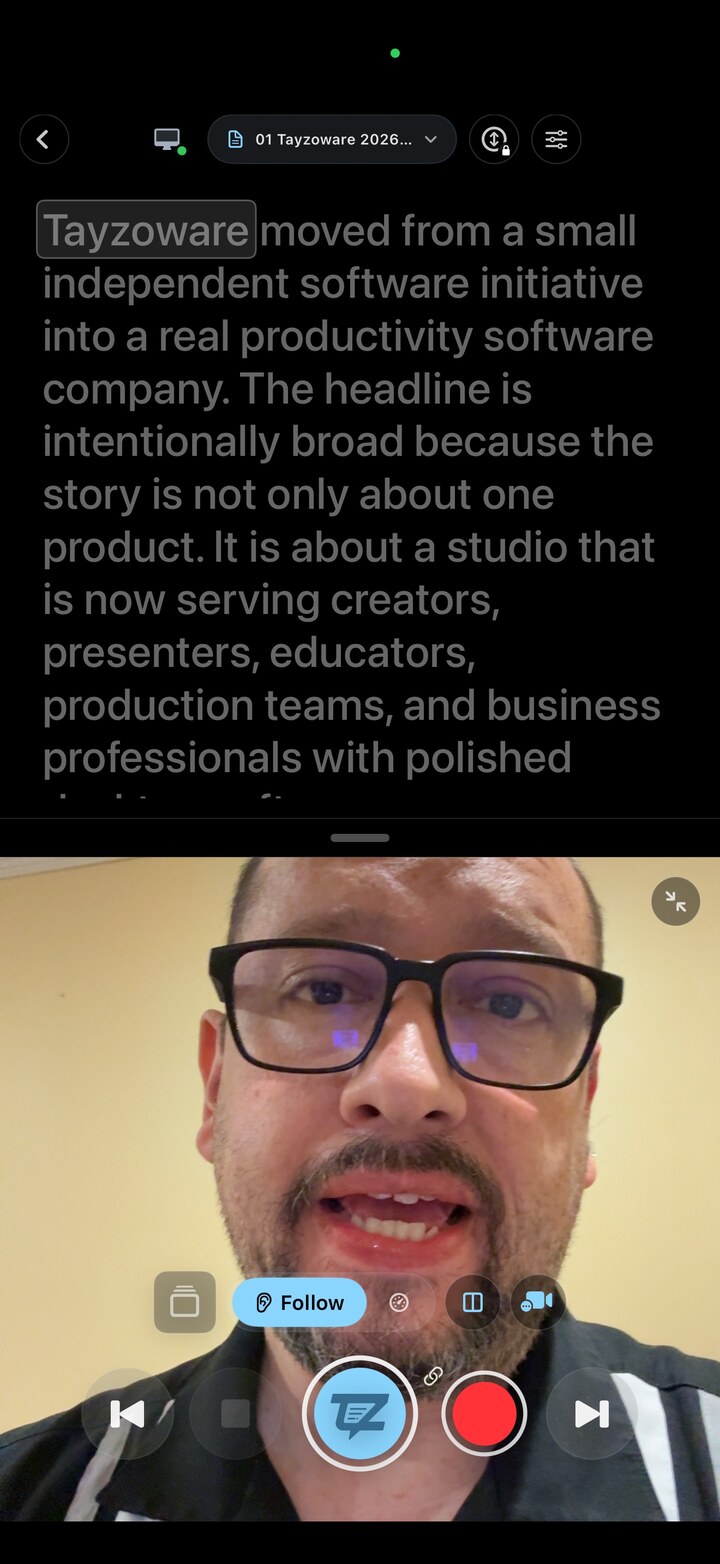
Speech follow working alongside the camera.
The work beyond the code
I was learning everything it takes to ship a real product.
At the same time, I found myself learning everything beyond programming that users never see.
- 01App Store reviews
- 02Subscriptions
- 03Licensing
- 04Screenshots and preview videos
- 05Discoverability
- 06Countless details no user should have to notice
I slowly realized I wasn't just writing software anymore.
I was learning how to build a product.
The difficult middle
Some ideas had to be simplified. Some features had to be rebuilt. Some decisions had to begin again.
Simplify→Rebuild→Start over→Learn
More than once I realized I wasn't solving a programming problem.
I was solving a human one.
The answer was rarely another feature
It was to remove friction
until the technology almost disappeared.
Today
TayzoPrompter helps people communicate with confidence.
Whether they're recording a presentation, teaching a class, delivering a keynote, or simply sharing an idea with the world.
What building it reminded me
The most meaningful software isn't built around technology.
It's built around people.